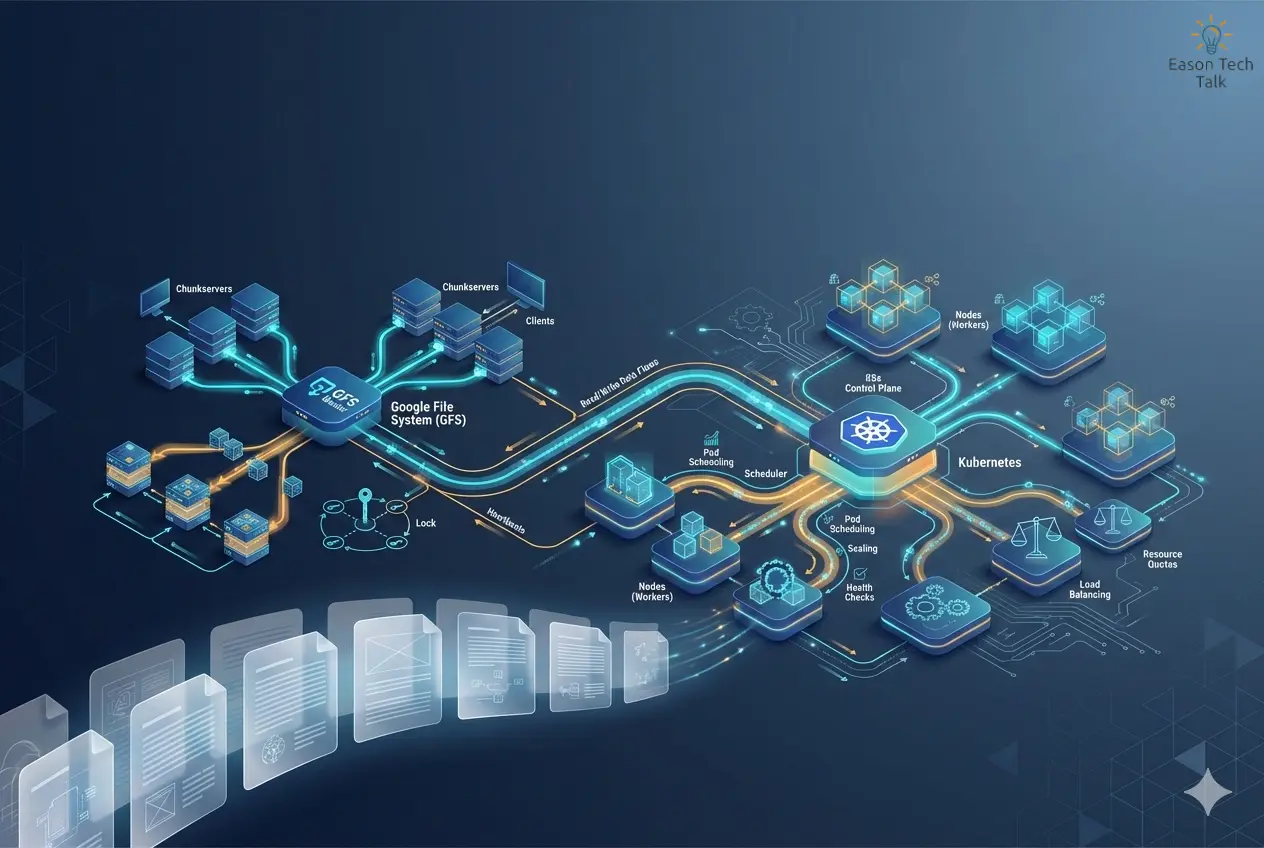
Essential Distributed Systems Readings for Kubernetes Engineers
I’m always fascinated by distributed systems and the beauty of science—the way it breaks complex problems into methodical, systematic pieces so we can build large-scale systems that remain stable and performant.
If you’re working with Kubernetes, learning from Google’s Borg experience, or tackling SRE operational challenges, I found these foundational papers will give you the theoretical grounding and practical insights you need. Each has shaped how we think about building and operating distributed systems at scale. These resources aren’t limited to software developers, system engineers, or site reliability engineers—they’re valuable for anyone working with distributed systems.
1. “The Google File System” (2003)
Summary: This paper describes GFS, Google’s distributed file system designed to run on commodity hardware while providing high aggregate performance to a large number of clients. It introduced novel approaches to handling failures as the norm rather than the exception.
Key Concepts: Component failures as normal behavior, large file optimization, atomic record append operations, relaxed consistency model, master-chunk server architecture.
Why Read It: Understanding GFS helps you grasp the storage foundations that underpin systems like Kubernetes persistent volumes. The design trade-offs between consistency and availability directly apply to storage orchestration in container platforms.
2. “MapReduce: Simplified Data Processing on Large Clusters” (2004)
Summary: MapReduce presents a programming model for processing large datasets with a parallel, distributed algorithm on a cluster. It abstracts away the complexity of parallelization, fault-tolerance, and load balancing.
Key Concepts: Map and reduce functions, automatic parallelization, fault tolerance through re-execution, locality optimization, master-worker architecture.
Why Read It: While Kubernetes doesn’t run MapReduce jobs directly, understanding this computation model helps when designing batch workloads and job schedulers. The principles of resource scheduling and fault recovery are fundamental to how Kubernetes manages workloads.
3. “Bigtable: A Distributed Storage System for Structured Data” (2006)
Summary: Bigtable is Google’s distributed storage system for managing structured data at massive scale. It provides a sparse, distributed, persistent multi-dimensional sorted map that scales to petabytes across thousands of machines.
Key Concepts: Column-family storage model, tablet servers, distributed lock service (Chubby), bloom filters, compaction strategies, SSTable file format.
Why Read It: Bigtable’s architecture influences modern stateful applications on Kubernetes. Understanding how it handles data distribution, replication, and consistency helps when running databases as StatefulSets or managing etcd (which stores Kubernetes cluster state).
4. “The Chubby Lock Service for Loosely-Coupled Distributed Systems” (2006)
Summary: Chubby is Google’s distributed lock service that provides coarse-grained locking and reliable storage for small amounts of data. It’s designed to provide distributed consensus in a reliable, available way.
Key Concepts: Distributed consensus via Paxos, lock service vs. consensus library trade-offs, advisory locks, event notification, master election.
Why Read It: Kubernetes uses etcd (based on Raft, similar to Paxos) for coordination and consensus. Understanding Chubby’s design decisions helps you appreciate how Kubernetes achieves leader election, service discovery, and distributed configuration management.
5. “Large-scale cluster management at Google with Borg” (2015)
Summary: This is the definitive paper on Borg, Google’s cluster management system that runs hundreds of thousands of jobs across many clusters. Borg is the direct predecessor to Kubernetes and shares many architectural concepts.
Key Concepts: Job and task model, Borgmaster and Borglet architecture, resource allocation (CPU, memory), priority and quota systems, bin packing, task preemption, naming and service discovery.
Why Read It: This is essential reading for anyone working with Kubernetes. You’ll recognize direct lineage in concepts like pods, ReplicaSets, namespaces, and the control plane architecture. Understanding Borg’s lessons learned (both successes and regrets) provides invaluable context for Kubernetes design decisions.
6. “Borg, Omega, and Kubernetes” (2016)
Summary: This paper traces the evolution from Borg through Omega (an experimental cluster scheduler) to Kubernetes. It articulates lessons learned and how those lessons influenced Kubernetes’s open-source design.
Key Concepts: Container-centric infrastructure, declarative configuration, reconciliation loops, shared-state architecture evolution, API-driven design, the importance of ecosystems over monoliths.
Why Read It: This paper bridges Google’s internal systems with the open-source Kubernetes you use today. It explains why Kubernetes works the way it does and helps you understand the philosophy behind its design choices, making you a more effective operator.
7. “Site Reliability Engineering” Book - Chapters 1-6 (2016)
Summary: The first chapters of Google’s SRE book establish the foundational principles of SRE: treating operations as a software problem, embracing risk, defining SLIs/SLOs/SLAs, and eliminating toil.
Key Concepts: SRE vs. DevOps, error budgets, Service Level Indicators/Objectives/Agreements, toil definition and elimination, monitoring and alerting philosophy.
Why Read It: Running Kubernetes clusters requires operational excellence. These chapters teach you how to think about reliability in quantifiable terms, which is crucial when setting up monitoring, alerting, and SLOs for your Kubernetes workloads and the platform itself.
8. “Omega: flexible, scalable schedulers for large compute clusters” (2013)
Summary: Omega represents Google’s next-generation scheduler design after Borg. It uses a shared-state approach with optimistic concurrency control, allowing multiple schedulers to operate in parallel.
Key Concepts: Shared-state scheduling, optimistic concurrency control, parallel schedulers, resource allocation flexibility, scheduler extensibility.
Why Read It: While Kubernetes doesn’t fully implement Omega’s architecture, understanding this evolution helps you appreciate the Kubernetes scheduler’s pluggability and extension mechanisms. It’s especially relevant if you’re implementing custom schedulers or scheduler extenders.
9. “Autopilot: workload autoscaling at Google” (2020)
Summary: Autopilot describes Google’s system for automatically rightsizing resource requests and limits for workloads. It uses ML-based recommendations and vertical pod autoscaling to optimize resource utilization.
Key Concepts: Vertical Pod Autoscaling (VPA), recommendation systems, resource optimization, memory and CPU rightsizing, safety mechanisms to prevent disruption.
Why Read It: Resource management is one of the hardest operational challenges in Kubernetes. This paper shows Google’s approach to solving the problem of over-provisioning and under-provisioning, which directly translates to the VPA and related autoscaling features available in Kubernetes today.
10. “The Tail at Scale” (2013)
Summary: This paper examines how variability in service times (tail latency) becomes a significant problem at scale. It presents techniques for reducing latency variability and improving overall system responsiveness.
Key Concepts: Tail latency amplification, hedged requests, tied requests, canary requests, good enough responses, latency-induced probation, synchronized disruption.
Why Read It: When running microservices on Kubernetes, tail latency can destroy user experience. This paper teaches you techniques for designing resilient service meshes, implementing proper timeout and retry policies, and understanding how distributed systems behave under load—all critical for SRE work.
Approach These Readings
Start with the Borg paper (#5) and “Borg, Omega, and Kubernetes” (#6) to build your mental model of how Kubernetes came to be. Then dive into the infrastructure papers (GFS, Bigtable, Chubby) to understand the storage and coordination foundations. Finally, work through the SRE and operational papers to learn how to run these systems reliably at scale.
Each paper represents years of production experience at massive scale. The patterns, anti-patterns, and trade-offs described in these readings will save you from repeating massive scale enterprises’ mistakes and help you leverage their successes in your own Kubernetes and distributed systems work.